
By Coral Gables Gazette staff
United States foreign policy has accelerated to historic levels already in 2026 with the capture of Venezuelan President Nicolás Maduro by US special forces in early January and the now ongoing conflict with Iran started in February. In Miami-Dade County, those developments have fueled speculation within the Cuban-American community about whether Cuba could be next, and what that might mean for both longtime exiles and recent arrivals.
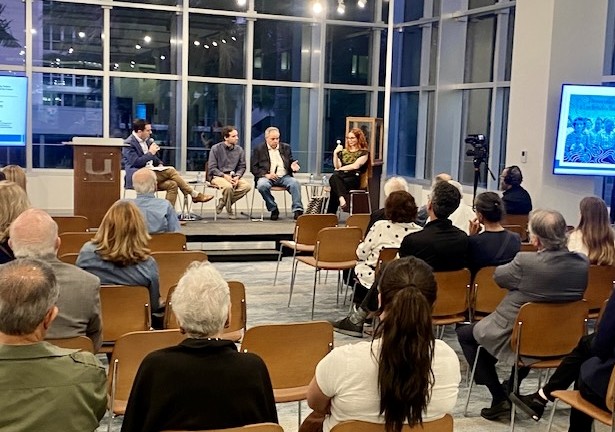
Against that backdrop, the University of Miami Cuban Heritage Collection hosted a panel discussion titled “Unsettled Futures” on April 2, examining recent Cuban migration, shifting U.S. immigration policy, and the evolving identity of Cuban Americans.
The panel, moderated by associate professor of history and chair of the university’s Cuba and Cuban-America studies Michael Bustamante, featured immigration attorney Wilfredo Allen, journalist Carla Gloria Colomé Santiago and advocate Thomas Kennedy. The event drew an audience of roughly 50 attendees.
A historic wave of migration
Bustamante opened by framing the current moment as the largest Cuban migration in modern history. Between 2021 and 2024, an estimated 1 to 2 million people left the island, with roughly 850,000 arriving in the United States – numbers that likely surpass earlier migration waves such as the Freedom Flights, Mariel boatlift, and balsero crisis combined.
Colomé Santiago, who has reported extensively on the exodus, described a profound shift in mood inside Cuba. During a 2022 visit outside Havana, she said she encountered something new: a sense of collective despair and “emptiness” that went beyond previous crises.
“What I saw was a kind of abyss,” she said, describing neighborhoods where people openly discussed leaving. “It became contagious – the idea that ‘I don’t want to be the last person in Cuba.’”
She pointed to the convergence of factors following the 2021 protests, includign economic collapse, shortages of food and medicine, and political repression, as creating what she called a “total loss of hope.” Independent estimates suggest Cuba may have lost as much as 18 percent of its population in recent years, with the current population potentially closer to 8 million.
Unlike earlier waves, she noted, this migration includes more women and families, often leaving through legal pathways in third countries such as Nicaragua. “This is not just migration,” she said. “It’s a demographic transformation.”
The end of exceptionalism
Panelists agreed that a defining feature of this moment is the erosion of Cubans’ historically privileged immigration status in the United States.
Bustamante noted that policies such as “wet foot, dry foot,” which once facilitated Cuban entry and residency, were eliminated in 2017. Since early 2025, legal pathways have narrowed further, increasing uncertainty and vulnerability for new arrivals.
Allen, who has practiced immigration law for four decades, described a stark change in enforcement. “From 1974 to 2025, I could count on one hand the number of non-criminal Cubans detained,” he said. “Now, detention is the biggest fear.”
He recounted cases of clients being detained after routine court appearances or minor encounters with law enforcement, with some transferred between facilities across multiple states. “It’s one battle after another,” he said, noting that even those pursuing legal status face prolonged detention.
He described one case in Hialeah where a woman who was the victim in a car accident was eventually detained because of her immigration status. Hialeah was one of the cities in the county that signed on to deputize city police to serve ICE functions. The City of Coral Gables was the first city to sign on, but Police Chief Ed Hudak has repeatedly insisted that city police would not “detain” victims as part of the agreement.
Kennedy added that Cubans are now fully embedded within the broader U.S. immigration system, subject to the same enforcement mechanisms as other groups. He pointed to increased cooperation between local law enforcement and federal immigration authorities, as well as rising detention numbers in South Florida.
“For a long time, many Cubans didn’t see themselves as immigrants in the same way,” Kennedy said. “That distinction is disappearing.”
An uncertain future
The panel also explored what lies ahead for both Cuba and its diaspora.
Speculation about political change on the island has intensified, particularly in light of regional instability. But panelists cautioned against assuming imminent transformation. “Don’t listen to politicians who say there’s a plan,” Allen said bluntly. “There isn’t.”
Colomé Santiago described a growing shift within the Cuban-American community itself, as recent arrivals confront legal and economic hardship. “For the first time, many Cubans feel part of something bigger than themselves—immigration as a whole,” she said.
She also noted increasing activism, from community organizing to public demonstrations, as migrants seek support and visibility. “If you don’t speak out, it doesn’t mean they’ll treat you better,” she said.
At the same time, tensions persist within the diaspora. Kennedy described a fragmented political landscape, with different groups pursuing narrow policy fixes rather than broader immigration reform.
Audience questions and community concerns
During the Q&A, attendees raised concerns ranging from deportations to geopolitical risks. One participant asked whether Cuba could become a future military target, given recent U.S. actions abroad. Others questioned the apparent contradiction between political support for hardline policies and their impact on Cuban families.
Several speakers pointed to rising deportation numbers, including thousands of Cubans sent back to the island or to third countries such as Mexico. One audience member described the emotional toll on families divided by detention and removal.
Another attendee highlighted the case of long-term U.S. residents facing deportation after decades in the country, prompting discussion about the limits of legal protections.
Panelists also addressed the complex political identity of the Cuban-American community, with some noting a cycle of support and disillusionment with U.S. leaders. “There’s a community that is suffering,” one speaker said, “while still hoping for change from the same system.”
When asked how Cuban-Americans could support President Donald Trump after they had voted for him in large numbers only for him to rescind some of the immigration protections, Colome Santiago was at a loss for words.
“I don’t know, I don’t have words. I’ve seen them go from love to hate to love, a return to glorification,” she said. “It may be people not wanting to admit something is happening, a community that is suffering, but then saying this is the man that is going to liberate us.”
The discussion concluded with a call for continued dialogue. Organizers announced that a follow-up panel in the coming weeks will focus on the politics of Cuba.

Author: Coral Gables Gazette News Staff
Originally established in 1996 and relaunched as a digital publication in February 2025, the Coral Gables Gazette is an independent local news organization dedicated to factual, objective and accountable community journalism. Our newsroom reports on the people, policies, institutions and events shaping Coral Gables, Florida, providing residents with timely, informative coverage of the issues affecting their community. Our reporting includes City Hall, local government, municipal elections, public spending, real estate development, business, education, arts and culture, and neighborhood affairs throughout the City Beautiful. We follow City Commission decisions, examine public records and report on the businesses, organizations and individuals contributing to Coral Gables. We believe informed residents are essential to a healthy, engaged community. Stories published under the Coral Gables Gazette News Staff byline are prepared or compiled by the publication's editorial team. We strive for accuracy, fairness, transparency and clear distinctions between news reporting, opinion and advertising. Readers are encouraged to submit news tips, corrections, editorial inquiries and story suggestions through our Contact page and learn more about our standards through our Editorial Policy.









I hope that they left their communist idealogy in Cuban. Along with their entitled attitude.
Unfortunately, this town’s name has changed to ME-A-ME.
Dialogue is very important! especially at these times, but the truth is far more important. passing judgment helps NO ONE!
References:
Hitnspin anmelden https://www.skoladesignu.sk/
References:
Lollybet Bonus cse.google.dz
References:
Hitnspin aktionscode http://cse.google.com.ni/url?sa=i&url=https://forums.ppsspp.org/member.php?action=profile&uid=6611580
References:
Payid pokies online https://smartcampus-seskoal.id/
References:
Online pokies with payid https://mcmguides.manuscript.com/
References:
Payid pokies aus kaymanuell.com
References:
Payid pokies aus https://www.100seinclub.com/bbs/board.php?bo_table=E04_1&wr_id=48711
References:
Lollybet Willkommensbonus http://tiwar.ru/?channelId=298&partnerUrl=https://raibio.vn/geraldantonio5/
References:
Lollybet Erfahrungen https://gameyop.com/gamegame.php?game=1&url=https://johnmuirsf.com/lilia62456768
References:
Lollybet Support https://91.cholteth.com/index/d1?diff=0&utm_clickid=cw0488o4c8wggkcc&aurl=https://goldenlink.club/jamesmcminn189&an=&s=&pushMode=popup