
By Coral Gables Gazette staff
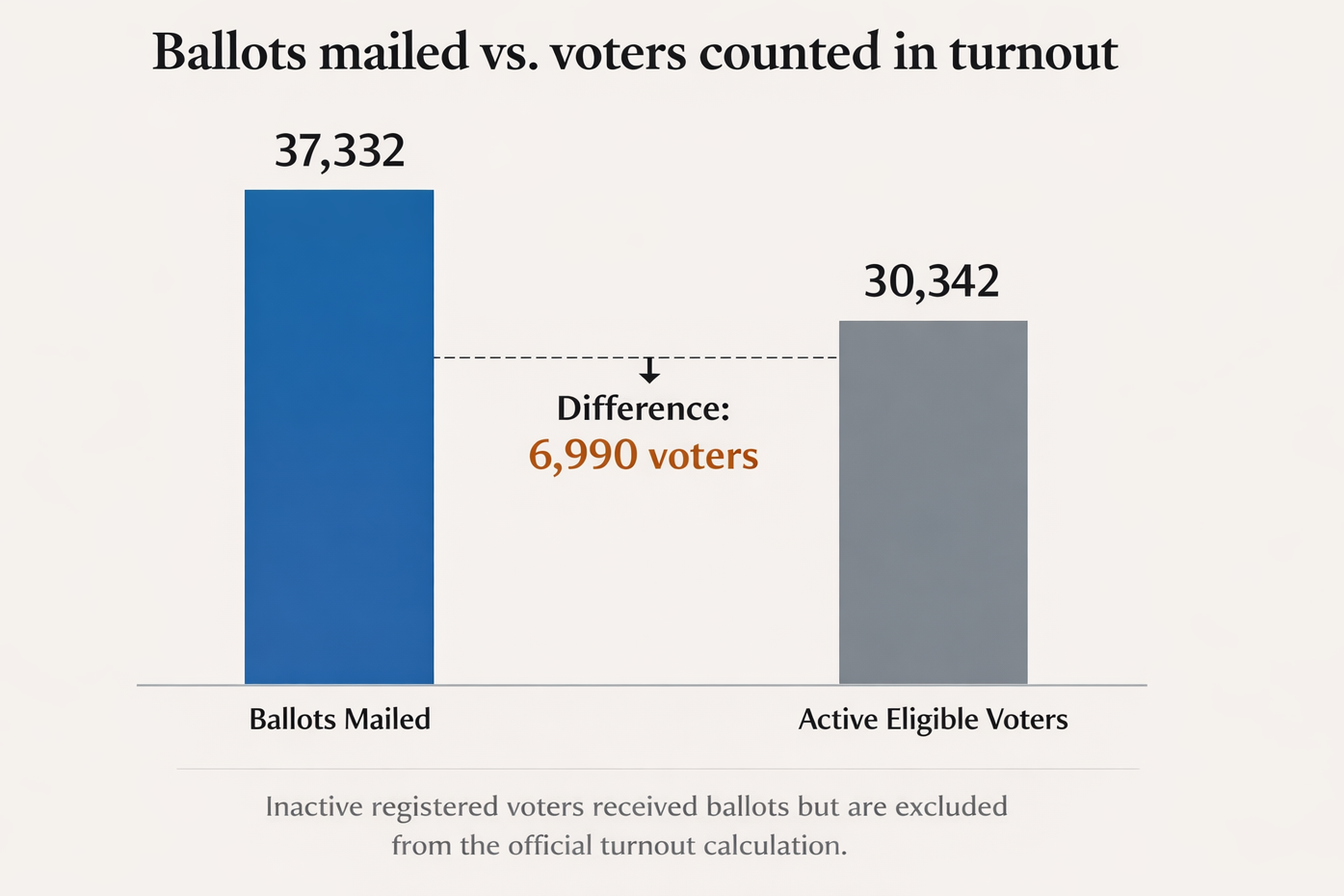
Coral Gables is three weeks from the April 21 deadline on its first-ever mail-only charter referendum, and as of Monday afternoon, 3,075 ballots had been returned out of 37,332 mailed to registered voters on March 19 — the starting gun for a special election in which residents will decide eight proposed amendments to the city charter. But buried in the Miami-Dade Supervisor of Elections’ own unofficial voter count, as of 4:20 p.m. on March 30, is a number that deserves scrutiny before the final tally is assessed: only 30,342 voters are listed as active and eligible — nearly 7,000 fewer than the number of ballots mailed — producing an unofficial turnout figure of about 10.1 percent with 22 days remaining.
The 6,990-ballot gap (18.7 percent) between those two figures reflects a distinction embedded in Florida election law. Under state statute, voters who have not cast a ballot in the past two general elections and have failed to respond to address confirmation notices are reclassified as inactive. They remain technically eligible to vote and, in this election, received ballots — but they are not counted in the active voter denominator the Supervisor uses to calculate turnout. In effect, thousands of households received ballots the turnout calculation does not expect back.
Who has voted so far
Of the 3,075 ballots returned, Republicans lead by a substantial margin. Republican voters account for 1,321 returned ballots, or 43 percent of the total — a notably higher share than their proportion of the active electorate would suggest. Democratic voters have returned 962 ballots, or 31.3 percent. Voters with no party affiliation have returned 733 ballots, or 23.8 percent, and voters registered to other parties account for the remaining 59.
The early Republican advantage in returns is consistent with a pattern that has emerged in mail-ballot elections nationally, where Republican voters — following years of party emphasis on early and mail voting — have increasingly led in initial return rates in down-ballot races. Whether that advantage holds through April 21 will depend in part on Democratic and no-party turnout in the election’s final weeks.
Where the ballots are coming from
Returns by precinct show significant variation across the city. Precinct 636, anchored by the Coral Gables Branch Library, leads all precincts with 410 returned ballots — more than four times the lowest-performing precinct. Precinct 601, assigned to the Country Club of Coral Gables, has returned 326 ballots. Precinct 611, based at Coral Gables Senior High School, has returned 282, and Precinct 604, at the American Legion Post, has returned 278.
At the other end of the spectrum, Precinct 646 — a Pinecrest branch library precinct — has returned just 23 ballots, the lowest of any precinct in the election. Precinct 635, at Christ Congregational Church, has returned 93, and Precinct 640, at the Watsco Center at the University of Miami, has returned 101.
The precinct-level variation likely reflects a combination of demographic factors, voter engagement with the specific referendum questions, and the degree to which different neighborhoods have historically participated in off-cycle local elections — the low-turnout elections that several of the referendum questions are designed to address by moving city contests to November.
What is on the ballot
The eight referendum questions cover a range of structural changes to how Coral Gables governs itself. The most consequential is Referendum 1, which would move city elections from April of odd years to November of even years beginning in 2026 — a change that would also cut the current terms of all five sitting commissioners by approximately four months. Referendum 2 would lock that change at the charter level, prohibiting future commissions from moving elections back by ordinance alone.
The remaining six questions address board member removal procedures, mandatory charter reviews every ten years, authorization for inspector general services, supermajority requirements to spend city reserves, voter approval requirements before elected officials’ compensation can be changed beyond annual cost-of-living adjustments, and a requirement that the city maintain reserves equal to 25 percent of its operating budget.
The election was placed on the April mail ballot by a 3–2 commission vote, with Mayor Vince Lago, Vice Mayor Rhonda Anderson, and Commissioner Richard Lara in favor and Commissioners Melissa Castro and Ariel Fernandez opposed. Commissioner Fernandez raised concerns at the time about the mail-only format, noting delivery problems in the city and arguing that the format risked disenfranchising voters who prefer or depend on in-person voting.
How to return a ballot
Voters who have not yet returned their ballots have until 7 p.m. on Tuesday, April 21. Ballots must be received — not merely postmarked — by that deadline. There is no cost to mail a ballot; a stamp is not required. Voters who prefer not to mail their ballot may drop it off in person only at the Miami-Dade Supervisor of Elections office at 2700 NW 87th Avenue in Miami. No other drop-off locations are available.
Voters must sign inside the red box on the back of the mail ballot envelope and include their complete residential address above the signature. Ballots missing a signature or residential address will not be counted, and ballot curing is not available for this election. Voters whose ballot was lost, destroyed, or not delivered may obtain a replacement by completing a Replacement Mail Ballot Oath through the Supervisor of Elections.

This Post Has 8 Comments
Also quite consequential, and not mentioned in the article, is the referendum seeking to eliminate runoff elections. That’s a slippery slope, leaving the door open to electing officials who don’t garner a clear majority of the vote. Not a good idea.
Again, the cost of a runoff is one of the reasons cited by Lago for wanting the change. But spending one million dollars on artwork in a city garage, excuse me, a “mobility hub”, doesn’t have anyone expressing concern?!!
I agree. We definitely need to have a candidate win by an actual majority.
How can I get a ballot if I still have not received one? I’m an active voter.
I am truly amazed that in these turbulent political times we live in, there are some 7,000 voters in CG who haven’t voted in the last two general elections. Do they not care or, have they just given up. Voting, no matter how you vote, is at the very foundation of the Republic. Being a non-participant in the operational decisions, at all levels of government, is critical to a healthy, stable and prosperous society. How do we get these people out to vote – that becomes the question for our elected leaders in CG.
Maybe they’ve died?
Not just shocking–terrifying.
A sign of real leadership is knowing when your time to pass the microphone is long overdue.
Even worse than the $10,000 wasted on 7,000 useless vote-by-mail ballots ($1.50 postage per ballot) is that only 3,160 have voted so far in this referendum. That is 10.4% of 30,342 total voters. Our last referendum vote was in November 2016 with the Presidential vote. The City Commission (that included Mayor Lago) unanimously chose to have in-person early voting at the library and election day voting at the precinct, ballot drop-off at the library and vote-by-mail in November because it costs $20,000 instead of $121,000 for a 2016 vote-by-mail (see pages 89 and 92 of the transcript for item F-4 at the April 12, 2016 Commission meeting) and because there would be more votes. 22,937 (72% of all Coral Gables voters) voted in 2016 on the runoff election question with over 69% voting for runoff elections. Why is Mayor Lago causing the City to spend an extra $130,000 for a vote-by-mail referendum (postage has doubled since 2016) that will have less than one-third of the 2016 voters and that was unanimously rejected by the 2016 Commission? If we had the referendum vote in November with normal voting and Referendum #1 passed (moving elections from April to November), we could have our next election in April 2027, cut terms short by 4 months and the first November vote in 2028 simultaneous with the Presidential election. Why is Mayor Lago afraid of more referendum voters? We have never had a vote-by-mail. This voting process costs significantly more money with significantly less voters. It is very suspect. That is one of the many reasons why I am voting NO to these consequential Charter proposals.
Just a note for clarity: the March 31 date refers only to the data snapshot. The actual ballot return deadline is April 21 at 7 p.m., and votes are counted through that final moment.