By Coral Gables Gazette staff
Five young men in a small Italian coastal town. One has just gotten a girl pregnant and must marry her. One is perpetually, cheerfully unemployed. One writes plays no one will ever produce. One chases women with the focused devotion of a vocation. And one watches all of them — quietly, a little sadly — from a remove that suggests he already knows he will leave.
That is the world of “I Vitelloni,” Federico Fellini’s 1953 masterwork, which screens Sunday, March 22, at 1 p.m. at the Bill Cosford Cinema on the University of Miami campus as part of the Sundays at the U with Movies series. Tickets are $6. University of Miami students attend free with a valid Cane card.
The film that made Fellini
By 1953, Federico Fellini had co-directed one film and directed one more on his own. Neither had announced him as the figure he would become. “I Vitelloni” changed that. It was his first commercial success, his first Oscar nomination — for best original screenplay — and, more importantly, the film in which he first demonstrated the ability to get genuinely deep into his characters rather than observing them from a comfortable ironic distance.
The title translates roughly as “the calves” or “the veal” — a contemptuous Italian slang for overgrown boys, men who have never quite committed to becoming adults. Fellini based the film on his own memories of Rimini, the small Adriatic town where he grew up, and on the friends he left behind when he departed for Rome at seventeen. The film is semiautobiographical in the way that the best Fellini always is: not documentary truth but emotional truth, which is the harder kind to fake.
The five protagonists are drawn with the specificity that comes from love and the clarity that comes from distance. Fausto is the rooster of the group, handsome and feckless, whose infidelities are treated with comic exasperation rather than moral condemnation. Alberto is the eternal child, still living with his mother, whose one extended scene of genuine anguish — at the town carnival, watching his sister elope with a married man — arrives with the force of something long suppressed. Leopoldo is the writer, the one who believes most earnestly in his own talent and suffers most comprehensively for that belief. Riccardo exists at the group’s cheerful, slightly dim periphery. And Moraldo is the one who watches — Fellini’s surrogate, the conscience of the film, the one who at the end boards the train and goes.
A hinge in one of cinema’s great careers
Film critic Tom Piazza has described “I Vitelloni” as occupying a nodal point in Fellini’s career — filmed between “The White Sheik” in 1952 and “La Strada” in 1954, it is the film where he first took definitive possession of his own themes. Arrested development in men. The pull between provincial life and the city. The melancholy of deserted nighttime streets. The sea as a presence rather than a backdrop. These are the preoccupations that would run through everything that followed — through the bitter social satire of “La Dolce Vita,” through the vertiginous self-examination of “8 1/2,” through the gilded nostalgia of “Amarcord.”
What makes “I Vitelloni” surprising to a viewer who arrives expecting full-blown Fellini is precisely how restrained it is. The camera is often static. The surreal grotesques that populate his later work are largely absent. The film proceeds with an almost neorealist discipline, grounded in the rhythms of small-town life — the piazza, the beach in winter, the carnival, the church. It is the least “Felliniesque” of the major films in surface style and the most Felliniesque in emotional substance, which is another way of saying it is the one where the emotion had not yet learned to hide behind spectacle.
A Fellini thread at the Cosford
The Bill Cosford Cinema has been threading Fellini through its programming with quiet intention. Earlier in the season the Sundays at the U series screened “Amarcord,” Fellini’s 1973 return to the provincial Italian town of his memory, which won the Academy Award for best foreign language film. Sunday’s screening of “I Vitelloni” places the earlier film beside the later one, allowing viewers who saw “Amarcord” to trace the arc backward to where the obsession began.
The Cosford is one of the last single-screen art house cinemas in South Florida, a non-profit venue that has served the University of Miami campus and the broader Coral Gables community for more than 60 years. Named for Bill Cosford, the Miami Herald film critic and UM adjunct professor who campaigned for the theater’s potential before his sudden death in 1994, it reopened in his honor in February 1995. The Sunday series, priced at $6 per screening, is among the most accessible film programming in the region.
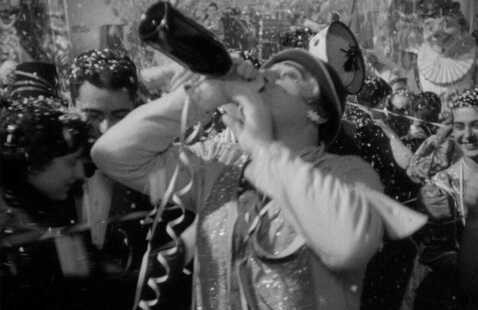
On Sunday afternoon the lights will go down in the Cosford’s single screen room and the Adriatic coast will appear in black and white — the off-season beach, the empty piazza, the carnival lights reflected in water. Five young men will stand at the edge of their lives, unable to move forward and unwilling to go back. One of them will eventually board a train. The rest will remain. Seventy years on, the film still knows exactly what that feels like.
Event details
What: Sundays at the U with Movies: “I Vitelloni” (1953), directed by Federico Fellini
When: Sunday, March 22, 1 to 3 p.m.
Where: Bill Cosford Cinema, Dooly Memorial 225, 5030 Brunson Drive, Coral Gables
Tickets: $6. University of Miami students free with valid Cane card. Available at cosfordcinema.com.